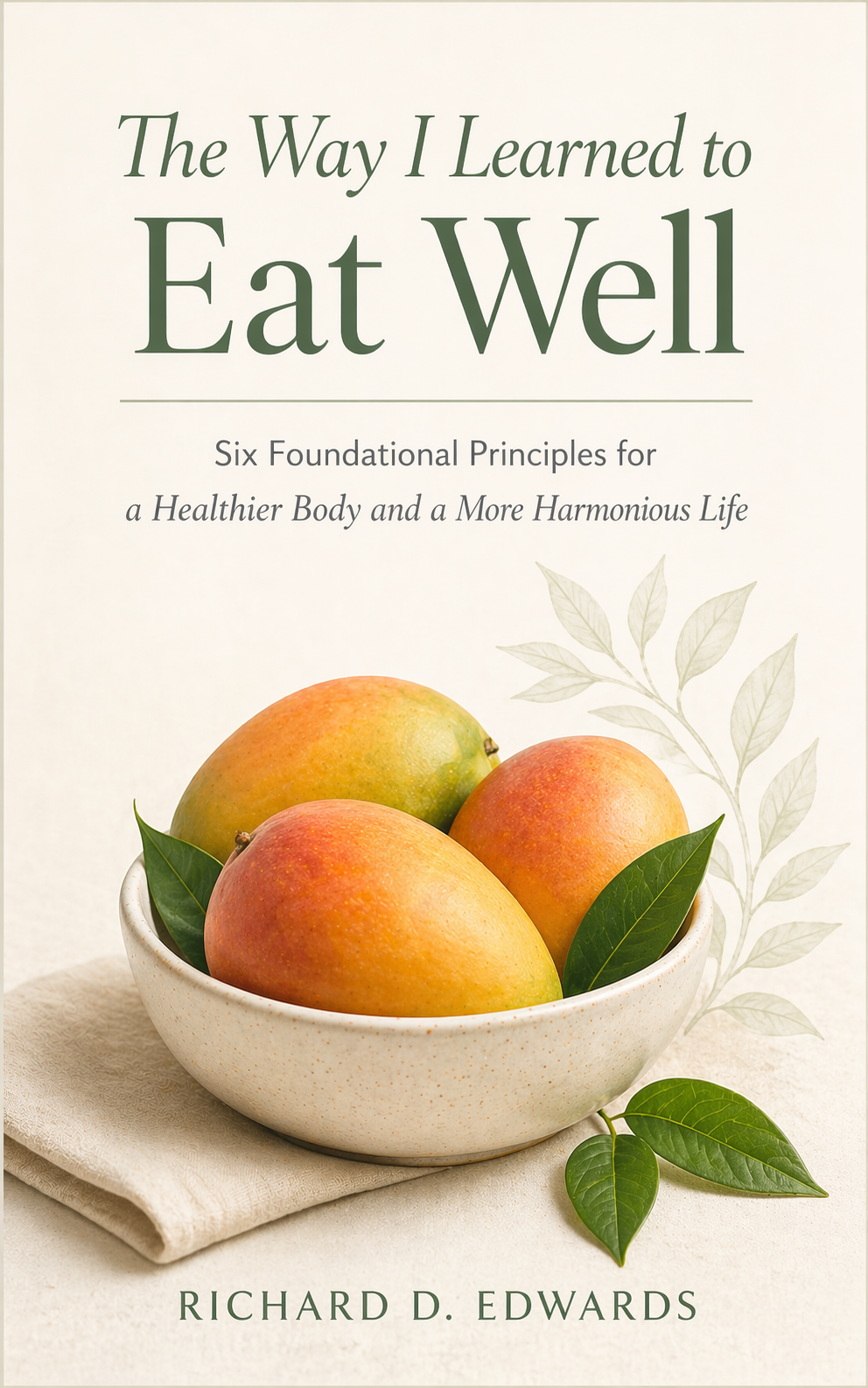
The Way I Learned to Eat Well — book cover by Richard D. Edwards
The Book

The Way I Learned to Eat Well

Six Foundational Principles for a Healthier Body and a More Harmonious Life

Most diets are built on the wrong foundation: restriction instead of understanding, willpower instead of knowledge, rules instead of principles. When the rules stop, the results stop with them. Real change happens when you understand how to eat. Not just what to eat.

What This Book Is. And What It Isn't.

The six principles don't belong to any particular school of thought. They don't require you to overhaul your life to apply them. They simply ask you to pay attention to your body, to your food, and to the connection between the two.

This book is

  • A set of six principles you understand, not rules you follow
  • Science-backed: every principle references peer-reviewed research
  • Flexible: it adapts to your life, your preferences, and the inevitable moments when things don't go to plan
  • Built for people who are ready to understand food, not just follow another plan
  • A framework you keep using for the rest of your life

This book is not

  • A diet plan, meal schedule, or list of foods to eat or avoid
  • A calorie-counting or macro-tracking system
  • A willpower challenge: it doesn't demand discipline or deprivation
  • A promise of quick results: it builds permanent understanding
  • Another trend with an expiry date
This book isn't a plan. It isn't a list of foods to eat or avoid. It's a set of principles. Six of them. They give you the understanding to make confident, nourishing decisions in any situation, for the rest of your life.

The Six Principles

Each principle builds on the one before it. By the end, you have a complete, flexible framework for eating well: one that adapts to your life, your preferences, and the inevitable moments when things don't go to plan.

Explore all six principles in depth →

Balance

How the body finds stability through food

Balance is the foundation everything else rests on. It is not about eating less. It is not about eating perfectly. It is about giving the body enough of the right things, at the right time, so it can do what it was designed to do.

When that happens, something settles. Energy steadies. Cravings quiet. The body stops sending distress signals and starts working with you instead of against you. Balance is the starting point. Everything that follows works better when balance comes first.

Balance calms the body before anything else can work. When meals are balanced, blood sugar stabilises, stress hormones quiet down, inflammation decreases, and hunger becomes trustworthy again.

Whole Foods

Why the body thrives on what it recognises

Modern nutrition has made eating feel complicated. Labels, macros, supplements, superfoods. Yet when you strip it all back, the body has always preferred the same thing: real food, in its simplest form. Whole foods are not a trend. They are the original design.

A landmark 2019 study in Cell Metabolism found that people consuming ultra-processed diets ate significantly more calories and gained more weight than those eating whole foods, despite matched macronutrients. The difference wasn't discipline. It was the food itself disrupting the body's ability to regulate intake.

The body doesn't need to be controlled when it's properly nourished. Eat closer to nature, and nature does much of the work for you.

Quality & Sourcing

Why where your food comes from matters as much as what it is

Food's story begins long before it reaches your plate. The soil it grows in, the farming practices used, the distance it travels, and how long it sits before being eaten all shape how nourishing it is. When you understand this, food stops being just calories or macronutrients. It becomes information your body responds to.

This principle covers the Dirty Dozen, how to read labels past the branding, why not all protein sources are equal, and how to make incremental sourcing upgrades that make a real difference without overhauling your budget.

Quality isn't about doing more. It's about choosing with intention. Don't outsource that judgment to a brand.

Optimize Absorption

How smart food pairings and gut health determine what your body actually uses

You could eat a perfectly balanced, carefully sourced, whole-food meal and still miss out on a significant portion of its nutritional benefit. That's because good nutrition isn't just about what's on your plate. It's about how effectively your body absorbs it.

The body doesn't reward effort at the plate. It rewards what actually reaches the cell. This principle covers smart food pairings (iron with vitamin C, fat-soluble vitamins with healthy fat, turmeric with black pepper), gut health, and the often-overlooked impact of how and where you eat.

Eating well is only half the equation. The other half is absorption: ensuring that what you eat actually reaches the cells that need it.

Hydration & Timing

The role of water and circadian rhythm in how the body processes food

Of all the principles in this book, this one is the most underestimated. Not because it's complicated. It isn't. But because water and meal timing are so familiar, so ordinary, that their impact on how the body functions is easy to dismiss. Until you experience what proper hydration and rhythmic eating actually feel like. Then it becomes difficult to ignore.

Water doesn't just support good nutrition. It enables it. Meal timing isn't about rigid schedules or eating by the clock. It's about rhythm: working with the body's natural circadian cycles rather than against them.

A 2022 study in The Journal of Nutrition found that even mild dehydration (as little as 1–2% reduction in body water) measurably reduces cognitive performance and increases fatigue. These effects set in before most people feel thirsty.

Fasting

The space in which the body repairs itself: autophagy, recovery, and renewal

Fasting is not about willpower. It is not about restriction or discipline or doing without. It is about understanding that the body has two modes, and that both of them matter. The fed state is where nutrition begins. But it is not where nutrition ends.

The fasted state is where something equally important happens: the body, freed from the constant work of digestion, turns its attention inward. To repair. To rebalance. To renew. The activation of autophagy (the body's internal cellular recycling system) was awarded the 2016 Nobel Prize in Physiology or Medicine.

In simple terms: when digestion stops, healing begins. Fasting is not deprivation. It is recovery.

Bonus Sections

Three additional chapters that round out the framework and make it immediately usable.

The Freedom to Enjoy

A closing chapter that brings all six principles together and addresses one of the most important things the book teaches: balance over perfection. Understanding the principles well enough to apply them flexibly, including at the dinner table with people you love.

Optimal Kitchen: The Game

24 common food items rated: Belongs in the Kitchen or Better Left Behind. A practical, direct reference that makes the principles immediately tangible. Not a strict list. A useful lens for building awareness about what's already in your fridge and cupboards.

Sources & Further Reading

Peer-reviewed citations for every principle: Cell Metabolism, The Journal of Nutrition, The New England Journal of Medicine, Environmental Health Perspectives, Frontiers in Sustainable Food Systems, and more. Every claim in the book has a source you can verify.

Ready to Read It?

Available on Amazon KDP in digital and physical formats.

Get the Book on Amazon

Frequently Asked Questions

What is The Way I Learned to Eat Well about?

The Way I Learned to Eat Well is a nutrition book by Richard D. Edwards built around six foundational principles: Balance, Whole Foods, Quality & Sourcing, Optimize Absorption, Hydration & Timing, and Fasting. It is not a diet plan. It is not a list of foods to eat or avoid. It's a set of principles. Six of them. They give you the understanding to make confident, nourishing decisions in any situation, for the rest of your life. No perfection required. No willpower either. They simply ask you to pay attention to your body, to your food, and to the connection between the two.

Who is this book for?

This book is written for adults who have tried diets that didn't stick. Not because they lacked discipline, but because restriction was never a sustainable foundation. It's for people who are curious about nutrition and want substance, not trends. For athletes and active individuals who want to support recovery and performance. And for anyone who has felt confused by conflicting nutrition advice and wants a framework they can actually trust and use long-term.

What are the six principles?

The six principles, in order, are: (1) Balance: building meals that sustain energy and calm the body's stress response; (2) Whole Foods: choosing ingredients your body recognises and knows how to use; (3) Quality & Sourcing: understanding that where food comes from affects what it can do for you; (4) Optimize Absorption: making sure the nutrients you eat are actually reaching the cells that need them; (5) Hydration & Timing: working with your body's natural rhythms rather than against them; (6) Fasting: giving your body the space it needs to repair and renew. Each principle builds on the one before it. Explore all six principles in depth →

How is this different from a diet plan?

Most diets are built on the wrong foundation: restriction instead of understanding, willpower instead of knowledge, rules instead of principles. When the rules stop, the results stop with them. This book builds understanding instead. The six principles don't require you to follow a schedule, count anything, or eliminate entire food groups. Your body doesn't thrive on rules. It thrives on balance, variety, and consistent nourishment. Once you have that understanding, the right choices stop feeling like discipline and start feeling obvious.

Is this book based on science?

Yes. Every principle in the book is grounded in peer-reviewed nutritional research. The book references studies published in Cell Metabolism, The Journal of Nutrition, The New England Journal of Medicine, Environmental Health Perspectives, and Frontiers in Sustainable Food Systems, among others. The discovery of autophagy (covered in the Fasting chapter) was awarded the 2016 Nobel Prize in Physiology or Medicine. A full sources and further reading section is included in the appendix.

Who is Richard D. Edwards?

Richard D. Edwards is an author and wellness advocate based in Costa Rica. He spent four years as a vegan before a deeper investigation of food labels and ingredient lists reshaped his understanding of the gap between health branding and genuine food quality. He volunteered for nearly three years with the Isha Foundation's Save Soil movement, working at the intersection of soil health, agricultural practice, and nutrient density. He competes in tennis seven to eight hours per week and has guided five friends and family members through these six principles personally, with results that included over 50 lbs of weight loss and across-the-board improvements in energy, digestion, and wellbeing. The six principles are what he wished had been written in one place when he started. Read Richard's full story →

Where can I buy the book?

The Way I Learned to Eat Well by Richard D. Edwards is available on Amazon KDP in both digital (Kindle) and physical formats. Use the button above or below to go directly to the Amazon listing.